Category restructuring

Emerging Market Distressed Debt, Brazil (part II).

One of the singular features of the Brazilian Bankruptcy Law (BBL) that was ‘modeled after the US Bankruptcy Code’ is the fact that Foreign Trade Lines and  Alienação Fiduciária (‘trust sale’ or ‘chattel mortgage’) are not only ‘outside’ of the 180 days ‘Automatic Stay’ period of the Recuperacao Judicial (‘RJ’,judicial recovery, Brazil’s version of Chapter 11 bankruptcy protection) but also, upon liquidation (Falencia), are granted super-priority status (as Credores Extraconcursais).

This priority was contested in local courts several times and was reaffirmed by the Superior Court of Justice by early 2013 – under Brazilian law, the Superior Court of Justice has the constitutional right to ‘defend and harmonize’ the interpretation of all Brazilian federal legislation, apart from the national Constitution, usually following decisions on the lower (state) courts.

Not surprisingly – this has triggered the somehow usual practice among local lenders of, whenever a company credit outlook is deteriorating to move its working capital lines to Foreign Trade lines – since this is business as usual for most exporters, this is not often contemplated in the Offering Memorandum and usually does not required waivers or authorization from Unsecured Creditors that before that were pari-passu with working capital lines and are now, in turn, being primed.

Another point in the same topic – given that there are no formal provisions for DIP finance in the Brazilian Bankruptcy Law (there are small mentions on Art. 67. and Art. 84. mostly related to suppliers and additional money from pre-petition creditors) – in ‘high-profile’ cases like ‘OGX’ – the DIP financing is structured as a trade-finance line to guarantee ‘super-priority’.

Upstream

-OSX Bond restructuring approved by the board – no haircuts, coupon goes from 9.25% to 13%, a PIK ‘consent fee’ of 2.5% and mandatory pre-payment if OSX-1 or 2 are sold, more here.
-‘There’s an uptick in [restructuring] activity and we expect that to continue through the rest of this year and next’, Brazilian distressed at The Wall Street Journal.
-Real Estate Cos. in the radar of Brazilian Distressed Debt investors,
-McKinsey&Co’s ‘New credit-risk models for the unbanked’
– Start-Up Chile is a program of the Chilean Government that seeks to attract world-class early stage entrepreneurs to start their businesses in Chile. The program provides US$40,000 of equity-free seed capital, and a temporary 1-year visa to develop your project for six months.

stoq#-9

Emerging Market Distressed Debt, Brazil (part I).

I have been ‘mapping’ the local Brazilian Distressed/Special Situations/High-Yield market for some time and will start a small series with specific topics – this is the first post – an introduction.
The intention here is NOT to cover all legal aspects – this is a practical introduction to anyone interested in Brazilian restructurings, distressed debt/special situations (and is probably analyzing now OGX,OSX, Lupatech, and Aralco among others).

A couple of data points:

Total credit expanded over 500% in the last 10 years – as of January, 2014 it reached 56.1% of GDP – BRL $2.7 trillion (~USD $1 trillion),

Corporate Credit represents roughly 54% of the total – average tenor (corporate credit) went from 5.7 months to 30.1 months,

-As of June,2013 – the 4 largest local banks held 74% of all credit,

-From April,2013 to March, 2014 the base local overnight rate (Selic) has climbed 300 bps to 10.75% p.a.

The ‘New Brazilian Bankruptcy Law’ (Law. 11101 dated February 9th, 2005) provides three procedures to address failing companies: (i) ‘Recuperação Extra-Judicial’ or out-of-court reorganization – a rarely used simplified procedure that does not includes ‘automatic stay’ or Trustee supervision, (ii) ‘Recuperação Judicial’ or Judicial Reorganization – that emulates Chapter 11 of the U.S. Bankruptcy Code and (iii)‘Falência’ or Liquidation – similar to Chapter 7 of the U.S. Bankruptcy Code.

State-owned entities and financial services companies (including Banks and Insurance companies) are NOT covered by the ‘New Brazilian Bankruptcy Law’.Local banks usually go from Central Bank intervention, followed by ‘Liquidacao Extrajudicial’ (out-of-court liquidation) also coordinated by the Brazilian Central Bank (a recent case here).

Brazilian Bankruptcy regulation was ‘inspired’ by US Bankruptcy law – but  unlike the U.S. Bankruptcy Code’s Chapter 15 – there is no mention of foreign creditors on the Law – the track record of local courts decisions on the issue (as per the recent cases of Independencia and OGX) does not indicate a clear path to include (or not) overseas subsidiaries/foreign investors in the Brazilian Bankruptcy case.

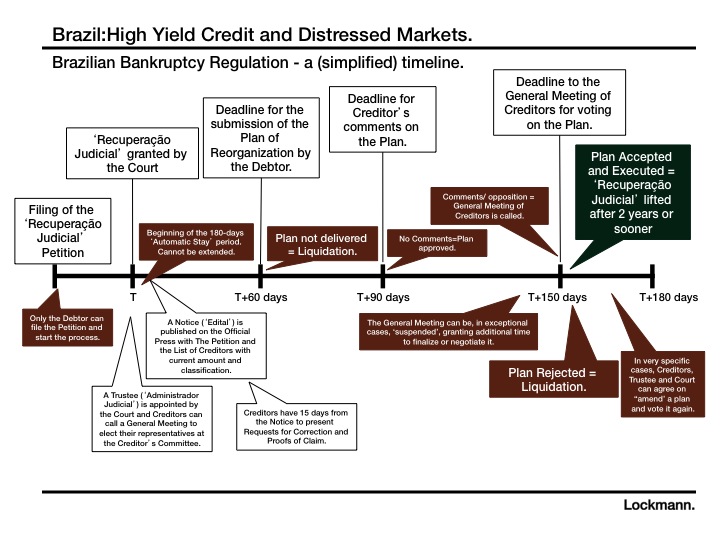
Below is a simplified schedule of a local Bankruptcy case (click to enlarge) and a couple of comments on the process:

•Recuperacao Judicial (‘RJ’) can only be filed by the Debtor and the Petition has to be filed in the Company’s main place of business and overseen by local court/judge – regardless of previous experience – with the possible exception of Rio and São Paulo that has two bankruptcy courts, most Brazilian civil courts have very limited familiarity with corporate lending/finance – what can lead to unusual outcomes .
LK-RJCalendar

•ACCs, ACEs (foreign trade lines) and ‘Alienacao Fiduciaria’ – credit backed by receivables etc. emulating the legal structure of a chattel mortgage – are not  subject to the ‘automatic stay’ under ‘Recuperação Judicial’ (as per Art.49 §3 of the Law and with recent backing by a decision of the Superior Court of Justice). More about this in a specific post.

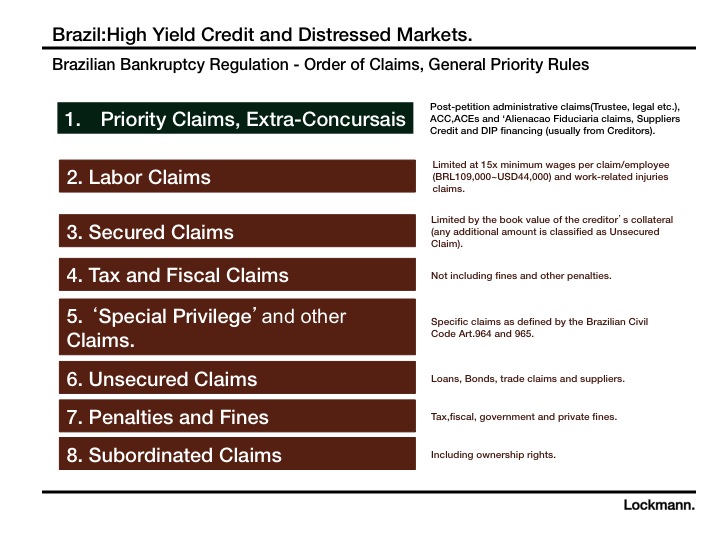
•A ‘major development’ of the (not so new now) Law was to put a cap on Labour claims (but priority over Secured Claims, continue) – please see below (click for enlarged version) – a simplified guide to the Order of Claims in a Brazilian bankruptcy case. Tax and Fiscal Claims still have seniority over Unsecured Claims.

LK-Claims

•DIP financing is not usual in Brazil and somehow ‘untested’ – that is probably why in the OGX case – creditors decided to use foreign trade lines – to add another line of safety to their claims. Prepackaged bankruptcies are virtually non-existent.

• Fast liquidation proceedings (‘Falência’) are also not common, especially  in high-profile medium/large bankruptcy cases –  even in the most obvious cases, liquidations are usually postponed for as long as possible  (in this case – the RJ/chapter 11 period dragged for over 5 years) – this obviously benefits the Debtor/Controlling shareholders and ‘forces’ creditors to accept a Plan of Reorganization that could be marginally better than waiting (a couple of years) for the outcome of a liquidation.

•Claims in foreign currency are automatically converted into local currency in the case of liquidation (‘Falência’) – creating immediate devaluation risk.

•The practical implications of the ‘New Brazilian Bankruptcy Law’ are being tested on a daily basis (the final outcome of the OGX/OSX case will certainly shape future cases, as it is already influencing cases like Aralco) –  and potential changes to the law can happen within the discussions of the new ‘Codigo Civil” in 2014/2015.

As per usual, any corrections, feedbacks and comments are appreciated. To be continued in further posts.

Upstream

“The best investment advice you’ll never get” via The Reformed Broker – also “don’t pay active fees for index-like performance.“,
-Japanese Banks (Mitsubishi UFJ, Mizuho and Sumitomo Mitsui) take the top three positions on Latin American Syndicated Loans Q1 2013  (Bloomberg league tables – page 8 here),
-How complex (and sometimes ineffective for foreign investors) collateral can be in Brazilian loans,
The Strange Case of the Ukrainian politician/head of meat inspections/meat trader and how a significant part of the meat imported from Brazil to Ukraine ends in Russia.
-Distressed Investment/Restructuring – two of the most important reads that you can find on line : Wachtell, Lipton, Rosen & Katz’s Distressed Mergers and Acquisitions and Houlihan Lokey’s Buying and Selling the Troubled Company 
-Something around $2.1 and $3.7 trillion will be invested in IT (roughly Brazil’s GDP and this is not including consumer spend) in 2013 according to either Forrester Research or Gartner – software is the bulk of spending and by 2014 Latin America will be where IT investment will be growing faster (via TechCrunch)
Google’s design (a BBC video) from1998 till now.

2012-Rinus-Van-de-Velde--The-Lost-Bishop-133648454862

Photograph: Stedelijk Museum Schiedam’s Rinus Van de Velde exhibition. Velde, The Lost Bishop.

Restructuring in Brazil 2012 – a (very) short overview.

An overview of restructuring/distressed activity in Brazil last year by the Cleary Gottlieb LatAm restructuring team posted at Latin Lawyer  – all major cases had significant government involvement.

“Brazil saw a more active restructuring market in 2012 with bankruptcy filings of a few highly leveraged issuers. Rede Energia, a distressed utilities holding company controlling eight power distribution entities throughout Brazil, filed for bankruptcy protection in November 2012 with a sale of the company expected to close in early 2013. Despite the successful transfer of former Rede subsidiary, Celpa, to the Brazilian utility company Equatorial Energia after its bankruptcy filing bankruptcy earlier last year, Rede continued to grapple with a quickly deteriorating financial structure. Meanwhile, newly enacted legislation aided the intervention by electricity regulator Aneel, which seized operational control of Rede’s eight subsidiaries last summer, and allowed Rede’s controlling shareholder to engage in exclusive negotiations for a sale of its assets to a consortium formed by Equatorial Energia and CPFL Energia. Although recent provisional measures have helped open the sales process up to other interested bidders, the events highlight the active role played by the Brazilian government as well as the accompanying challenges created for creditors in restructurings in Brazil.

Distress in Brazil’s banking industry has also highlighted the active role played by government and the difficulties faced by creditors seeking to engage in a restructuring in the financial sector. The banking industry in Brazil has seen frequent regulatory intervention in recent years as the country’s booming economy has begun to slow and the industry struggles to find long-term financing. Banco Cruzeiro do Sul attempted to restructure its debt in 2012 following the banking regulator’s discovery of accounting inconsistencies. Bondholders initially confronted the choice of accepting a steep haircut in a tender offer conducted by Brazil’s Depositary Insurance Fund (FGC), which assumed control of the bank last summer, or facing liquidation. Although the tender offer obtained the requisite level of creditor approval, the restructuring was conditioned on FGC’s successful sale of the bank and it ultimately entered liquidation proceedings following a failed sales process last September, highlighting the difficulty of conducting restructurings in highly-regulated industries.”