Category Emerging Markets

Upstream

The Rohatyn Group became one of the largest emerging-markets-focused private-equity funds in the world, with more than $7 billion in assets under management after it acquired Citi Venture Capital International from Citibank,
Something Ventured – PBS’ brilliant documentary on early Venture Capitalists,
– Gladwell rephrases the Ten-Thousand-Hour-Rule:”…in instances where there are not a long list of situations and scenarios and possibilities to master—like jumping really high, running as fast as you can in a straight line—expertise can be attained a whole lot more quickly…In cognitively demanding fields, there are no naturals.
-“I’ve done the calculation and your chances of winning the lottery are identical whether you play or not.” Fran Lebowitz, always on point,
– “and may you always remember that obstacles in the path are not obstacles, they are the path.”

stoq#-7

Upstream

“The days are long gone when “emerging markets” could be seen as a single asset class”
-Hyperbole,hyperbole: “The Death of an Asset Class?” by Keynes’ euthanasia of the rentier, no less – by GMO’s James Montier
“Google plans to make real-time translation devices that will translate language for simple conversation across language barriers.”
– Lisbon architect Nuno Simões’s series of staircases and walkways at an historic cave near Évora, Portugal (via Dezeen).

stock13-6

Upstream

“The best investment advice you’ll never get” via The Reformed Broker – also “don’t pay active fees for index-like performance.“,
-Japanese Banks (Mitsubishi UFJ, Mizuho and Sumitomo Mitsui) take the top three positions on Latin American Syndicated Loans Q1 2013  (Bloomberg league tables – page 8 here),
-How complex (and sometimes ineffective for foreign investors) collateral can be in Brazilian loans,
The Strange Case of the Ukrainian politician/head of meat inspections/meat trader and how a significant part of the meat imported from Brazil to Ukraine ends in Russia.
-Distressed Investment/Restructuring – two of the most important reads that you can find on line : Wachtell, Lipton, Rosen & Katz’s Distressed Mergers and Acquisitions and Houlihan Lokey’s Buying and Selling the Troubled Company 
-Something around $2.1 and $3.7 trillion will be invested in IT (roughly Brazil’s GDP and this is not including consumer spend) in 2013 according to either Forrester Research or Gartner – software is the bulk of spending and by 2014 Latin America will be where IT investment will be growing faster (via TechCrunch)
Google’s design (a BBC video) from1998 till now.

2012-Rinus-Van-de-Velde--The-Lost-Bishop-133648454862

Photograph: Stedelijk Museum Schiedam’s Rinus Van de Velde exhibition. Velde, The Lost Bishop.

Upstream

-New regulation (and recapitalization)  will bring “tremendous mispricing between the different levels of the capital structure” in Banks: Blue Mountain’s James E. Staley.
Recent trends in Latin American High Yield Offerings,
-“Prepackaged Bankrupcy/Restructuring” in Delaware – “The Curious Case of the European Vodka Seller” by The New York Times,
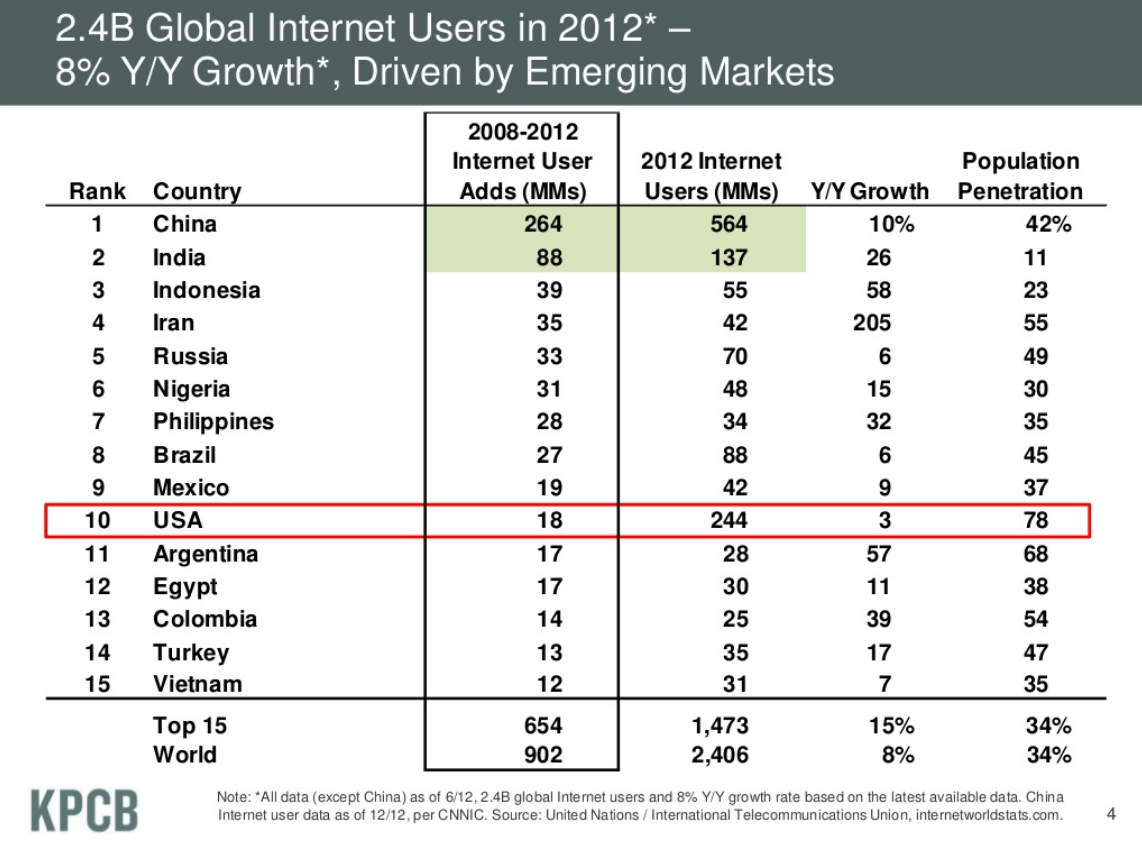
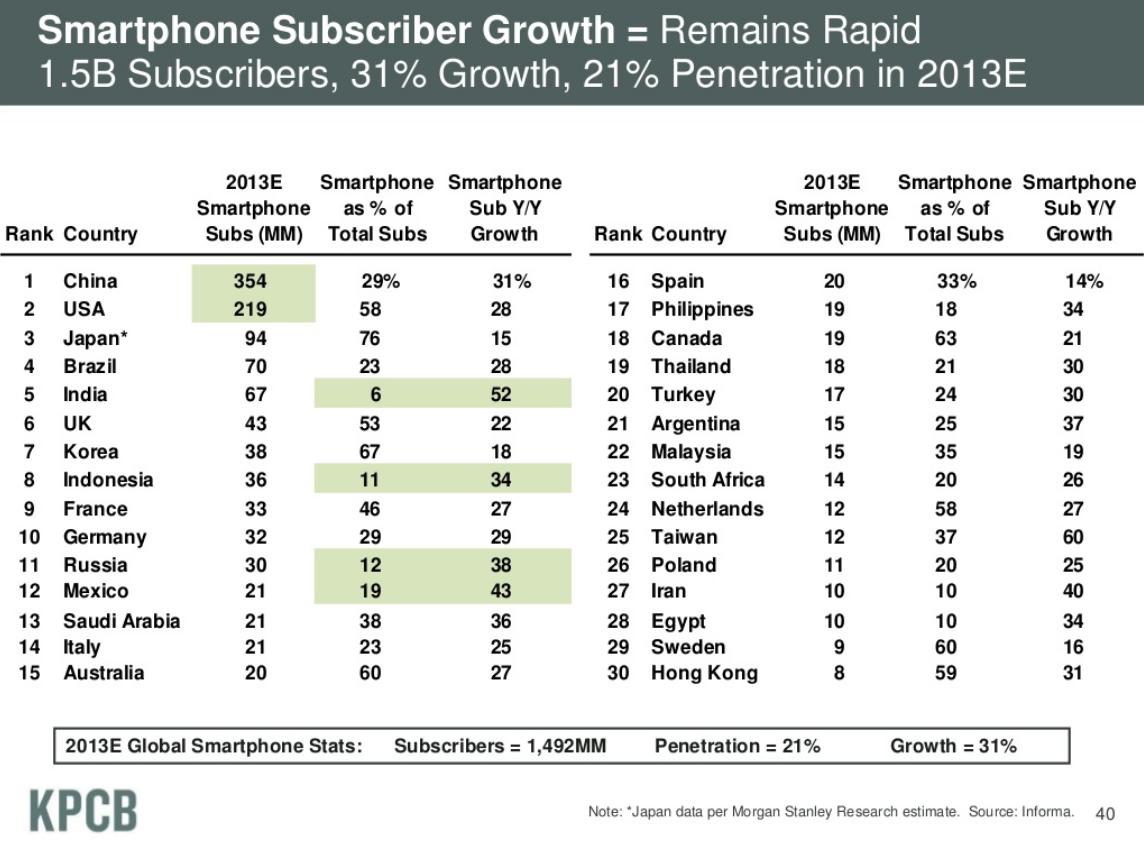
– Last week: Mary Meeker’s Annual Internet Trends Report: mobile momentum,wearables and China -main slides mentioning Brazil below – mobile, mobile….,
A brilliant review of one of Paris’ worst restaurants (via @GeorgesJanin) : ” Why do they continue to come here?….The only rationally conceivable answer is: Paris, Paris exerts a mercurial force field….it defies judgment.”

Screen Shot 2013-06-05 at 2.27.57 PM

Screen Shot 2013-06-05 at 2.30.13 PM

Upstream

-“We want to traffic in areas where there is  not a lot of capital chasing for returns”,
-“Hackers are the animals that can detect a storm coming or an earthquake…there are two big things hackers are excited about now: Bitcoin and 3D printing.
-“Trust is good, control is better” – list of all Borgen episodes (with the opening quotes),
This is probably one of the best, most subtle and intelligent reviews of Upstream Color, one of the most interesting films of the year.

stoq#-13

Reading Material

– Credit/Debt trading Hedge-Funds expanding rapidly and Third point seeking an IPO for its reinsurance arm,
– How Broadcast (antenna) networks can rake billions by going cable-only by The Verge (in the US, not sure if this works for EM, specially Brazil),
-Following up on the series Brian Eno in Finance (first installment: Eno’s letter to Nassim Taleb via The Drunkeynesian) this is Eno talking to Cambridge University Economist Ha Joon-Chang,
– Cervante’s Ocho Comedias for $145,000 and a first edition of Raymond Chandler’s Big Sleep for $19,000: browsing Bauman rare books.

IMG_1814

Reading Material

stoq#-11

-“Do not put your hand in front of a train, that’s what the Internet (video,tv,cable) is…
-Michael Milken and the corporate financing cube,
-Brazilian inflation-linked bonds are about 60 per cent of total EM inflation-linked bonds,
-Inside Amazon’s giant fulfillment center,
-Famous writers and their other jobs,
-Salmon Rushdie on moral courage.

Reading Material

Leviathan Evolving: New Varieties of State Capitalism by Harvard’s Aldo Musacchio and Sergio G. Lazzarini,
-Third Point’s Daniel Loeb on video (long, but brilliant),
-Also on video: Nassim Taleb at Stanford (via Farnam Street)
Brooklyn Bridge Ventures‘ Charlie O’Donnell on “The Money and Interestingness Trade
-John le Carré at The Times: ” a brilliant writer for whom spies are merely subject matter“.

stoq-1-12

Restructuring in Brazil 2012 – a (very) short overview.

An overview of restructuring/distressed activity in Brazil last year by the Cleary Gottlieb LatAm restructuring team posted at Latin Lawyer  – all major cases had significant government involvement.

“Brazil saw a more active restructuring market in 2012 with bankruptcy filings of a few highly leveraged issuers. Rede Energia, a distressed utilities holding company controlling eight power distribution entities throughout Brazil, filed for bankruptcy protection in November 2012 with a sale of the company expected to close in early 2013. Despite the successful transfer of former Rede subsidiary, Celpa, to the Brazilian utility company Equatorial Energia after its bankruptcy filing bankruptcy earlier last year, Rede continued to grapple with a quickly deteriorating financial structure. Meanwhile, newly enacted legislation aided the intervention by electricity regulator Aneel, which seized operational control of Rede’s eight subsidiaries last summer, and allowed Rede’s controlling shareholder to engage in exclusive negotiations for a sale of its assets to a consortium formed by Equatorial Energia and CPFL Energia. Although recent provisional measures have helped open the sales process up to other interested bidders, the events highlight the active role played by the Brazilian government as well as the accompanying challenges created for creditors in restructurings in Brazil.

Distress in Brazil’s banking industry has also highlighted the active role played by government and the difficulties faced by creditors seeking to engage in a restructuring in the financial sector. The banking industry in Brazil has seen frequent regulatory intervention in recent years as the country’s booming economy has begun to slow and the industry struggles to find long-term financing. Banco Cruzeiro do Sul attempted to restructure its debt in 2012 following the banking regulator’s discovery of accounting inconsistencies. Bondholders initially confronted the choice of accepting a steep haircut in a tender offer conducted by Brazil’s Depositary Insurance Fund (FGC), which assumed control of the bank last summer, or facing liquidation. Although the tender offer obtained the requisite level of creditor approval, the restructuring was conditioned on FGC’s successful sale of the bank and it ultimately entered liquidation proceedings following a failed sales process last September, highlighting the difficulty of conducting restructurings in highly-regulated industries.”