Category Emerging Markets

Upstream

stoq#-8

-” In the end, the devil usually wins. Caution, maturity and doing the right thing are old-fashioned ideas.” Oaktree’s Howard Marks talking to Finanz und Wirtschaft.
The Italian NPL Market – the Mergermarket/PWC assessment.
– “I have more fight than anyone needs for any job, I said. I’ve come a long way, from a mud hut in the rainy season in a part of the world you only know as a basket case of misery…..I’ve been beaten black and blue my whole short life and I’ve made it here. Have I got the fight? You tell me.” James Wood at the New Yorker writing about the best novel of the year (so far): Zia Haider’s “In the Light of What We Know”.
“Não tenho medo do fracasso. De fracasso em fracasso, a gente aprende. Tudo o que não fiz no cinema fiz em quadrinhos. As pessoas que fazem uma única coisa vão à lona quando fracassam.” ,Alejandro Jodorowsky at 85.


Upstream

-The Journal of Structured Finance Articles:   “Analyzing Brazilian ABS: FIDCs” and  “Pricing Brazilian ABS to Trade in the Secondary Market: Benefits from Assimilating Best Pricing Practices” by Vernon Budinger.
– “Banks are going to slowly look more and more like utilities,” Novogratz said.
“Every year you need to start from scratch again,” Quemada said. “Life at a small boutique is really tough.”
“Life will be harder for traditional active-fund-management companies. Their market share is being eroded by the ETFs at the bottom and by private-equity and hedge funds at the top”
– A brilliant New Yorker article on Soylent, the food-replacement start-up – full of quotables: ““This is life—a walking chemical reaction” ,“Most ideas, you can claim, are not new….Often, they just haven’t been executed or marketed right.”

photo

São Paulo, abstract wall painting at RB Station,Praça da Bandeira,República –  a former electrical substation turned into art gallery.

Upstream

-‘Apollo Global, the private equity and distressed debt specialist co-founded by Leon Black, is starting a unit to primarily buy investment-grade and high-yield corporate debt from Latin America and Asia‘.
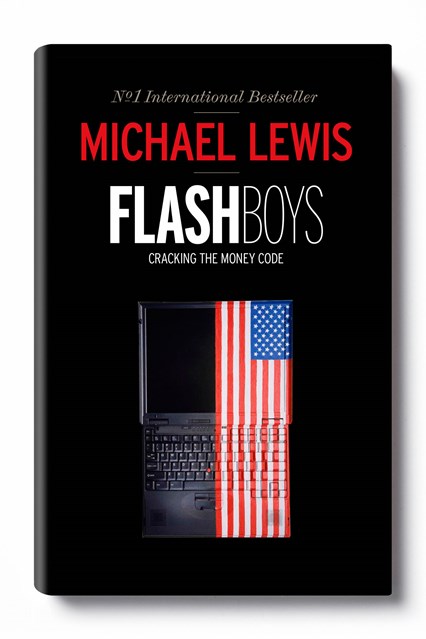
Fantastic piece by Alex Preston on Michael Lewis’ ‘Flash Boys’.
-Not so new, but still amazing – according to market researcher Euromonitor, Brazil, overtaking Japan as the World’ second largest beauty market, the Forbes take.
-On how Mies van der Rohe was commissioned to design the Seagram Building by (among other reasons) paying a compliment to Le Corbusier, a brilliant article in the  London Review of Books by Christopher Turner.
-‘We should honour Pascal, and the long line of pessimistic philosophers to which he belongs, for doing us the incalculably great favour of publicly and elegantly rehearsing the facts of life‘.

CopanSP

Emerging Market Distressed Debt, Brazil (part II).

One of the singular features of the Brazilian Bankruptcy Law (BBL) that was ‘modeled after the US Bankruptcy Code’ is the fact that Foreign Trade Lines and  Alienação Fiduciária (‘trust sale’ or ‘chattel mortgage’) are not only ‘outside’ of the 180 days ‘Automatic Stay’ period of the Recuperacao Judicial (‘RJ’,judicial recovery, Brazil’s version of Chapter 11 bankruptcy protection) but also, upon liquidation (Falencia), are granted super-priority status (as Credores Extraconcursais).

This priority was contested in local courts several times and was reaffirmed by the Superior Court of Justice by early 2013 – under Brazilian law, the Superior Court of Justice has the constitutional right to ‘defend and harmonize’ the interpretation of all Brazilian federal legislation, apart from the national Constitution, usually following decisions on the lower (state) courts.

Not surprisingly – this has triggered the somehow usual practice among local lenders of, whenever a company credit outlook is deteriorating to move its working capital lines to Foreign Trade lines – since this is business as usual for most exporters, this is not often contemplated in the Offering Memorandum and usually does not required waivers or authorization from Unsecured Creditors that before that were pari-passu with working capital lines and are now, in turn, being primed.

Another point in the same topic – given that there are no formal provisions for DIP finance in the Brazilian Bankruptcy Law (there are small mentions on Art. 67. and Art. 84. mostly related to suppliers and additional money from pre-petition creditors) – in ‘high-profile’ cases like ‘OGX’ – the DIP financing is structured as a trade-finance line to guarantee ‘super-priority’.

Upstream

-Home Equity Loans or , in Portuguese, CGI (Crédito com Garantia de Imóvel) are poised to grow at least 40% p.a. in Brazil as per Valor Economico.
– A new Michael Lewis book, ‘Flash Boys: A Wall Street Revolt’, apparently about High Frequency Trading will be out March,31st  (UK cover below).
-Kierkegaard said: “Anxiety is the dizziness of freedom,” The FT on The Joy Of Stress.
“We believe the cider category continues to be emerging and growing”

FlashBoys

Brazil:Local Credit Markets Overview

Brazil’s Central Bank’s –  March, 2014 Financial Stability Report is out today, and it gives a decent macro picture of the local credit/bank loan market:

-Bottom line  – Credits is (slowly) decelerating and local banks are focusing on mortgages.  No news or breakdown of how much of this growth is related to government programs (Nossa Casa Nossa Vida) but the Central Bank has issued guidelines/new regulations for the market (more details here).

-Total Credit (total credit inventory in the Brazilian Financial system, excluding local and overseas capital markets) reached BRL $ 2.7 trillion (~ USD $1.1 trillion), 56.5% of GDP with a 14.6% YoY growth

-Credit growth was driven mainly by public-sector banks a 22.6% yoy growth of the credit versus 7.3% yoy growth of privately owned banks

-Both public and privately owned banks continue the movement out of more risk consumer credit lines (overdrafts, autocar loans) and working capital towards mortgages and payroll loans (‘credito consignado) – with public banks now leading the market on autocar loans and working capital lines.

-Consumer Credit represents roughly 46% of total credit – and mortgages (‘credito imobiliario’) are now the largest part of it (27.3%) with a 33.7% YoY growth (and this is where Public and Privately-Owned banks are competing head to head – mortgage growth on Privately-owned banks was 31.5% compared with 34.2% at Public banks).

-As of December, 2013 77% of the mortgage stock were loans granted during 2011-2013 period (pre-slowdown) and the stock still carries a Loan-to-Value of 66.3% (not considering any increases on real estate value), current average LTV (Dec.2013) is 70.1%

-Corporate bank loans are 56% of Total Credit, it continues to slowly lose share to Capital Markets but still represent 63.1% of the ‘Total Indebtedness’ of local corporations.

-Even considering the recent BRL devaluation (that may distort numbers here) – there’s a clear tendency of local Banks towards large corporations (but SMEs still represent 46.8% of total corporate credit) and into foreign trading lines (out of unsecured working capital lines) – reflecting the economic slowdown/credit quality deterioration.

-Aggregated figures on delinquency (and spreads) at the report are usually not very useful but the overall delinquency rate (over 90 days) was 3.0% as of December 2013, 4.4% on the consumer side and 1.8% on the corporate side.

As usual – send me any corrections, comments.

Copan Building, Oscar Niemeyer, São Paulo, Brazil.

Copan Building, Oscar Niemeyer, São Paulo, Brazil.

Upstream

-OSX Bond restructuring approved by the board – no haircuts, coupon goes from 9.25% to 13%, a PIK ‘consent fee’ of 2.5% and mandatory pre-payment if OSX-1 or 2 are sold, more here.
-‘There’s an uptick in [restructuring] activity and we expect that to continue through the rest of this year and next’, Brazilian distressed at The Wall Street Journal.
-Real Estate Cos. in the radar of Brazilian Distressed Debt investors,
-McKinsey&Co’s ‘New credit-risk models for the unbanked’
– Start-Up Chile is a program of the Chilean Government that seeks to attract world-class early stage entrepreneurs to start their businesses in Chile. The program provides US$40,000 of equity-free seed capital, and a temporary 1-year visa to develop your project for six months.

stoq#-9

Emerging Market Distressed Debt, Brazil (part I).

I have been ‘mapping’ the local Brazilian Distressed/Special Situations/High-Yield market for some time and will start a small series with specific topics – this is the first post – an introduction.
The intention here is NOT to cover all legal aspects – this is a practical introduction to anyone interested in Brazilian restructurings, distressed debt/special situations (and is probably analyzing now OGX,OSX, Lupatech, and Aralco among others).

A couple of data points:

Total credit expanded over 500% in the last 10 years – as of January, 2014 it reached 56.1% of GDP – BRL $2.7 trillion (~USD $1 trillion),

Corporate Credit represents roughly 54% of the total – average tenor (corporate credit) went from 5.7 months to 30.1 months,

-As of June,2013 – the 4 largest local banks held 74% of all credit,

-From April,2013 to March, 2014 the base local overnight rate (Selic) has climbed 300 bps to 10.75% p.a.

The ‘New Brazilian Bankruptcy Law’ (Law. 11101 dated February 9th, 2005) provides three procedures to address failing companies: (i) ‘Recuperação Extra-Judicial’ or out-of-court reorganization – a rarely used simplified procedure that does not includes ‘automatic stay’ or Trustee supervision, (ii) ‘Recuperação Judicial’ or Judicial Reorganization – that emulates Chapter 11 of the U.S. Bankruptcy Code and (iii)‘Falência’ or Liquidation – similar to Chapter 7 of the U.S. Bankruptcy Code.

State-owned entities and financial services companies (including Banks and Insurance companies) are NOT covered by the ‘New Brazilian Bankruptcy Law’.Local banks usually go from Central Bank intervention, followed by ‘Liquidacao Extrajudicial’ (out-of-court liquidation) also coordinated by the Brazilian Central Bank (a recent case here).

Brazilian Bankruptcy regulation was ‘inspired’ by US Bankruptcy law – but  unlike the U.S. Bankruptcy Code’s Chapter 15 – there is no mention of foreign creditors on the Law – the track record of local courts decisions on the issue (as per the recent cases of Independencia and OGX) does not indicate a clear path to include (or not) overseas subsidiaries/foreign investors in the Brazilian Bankruptcy case.

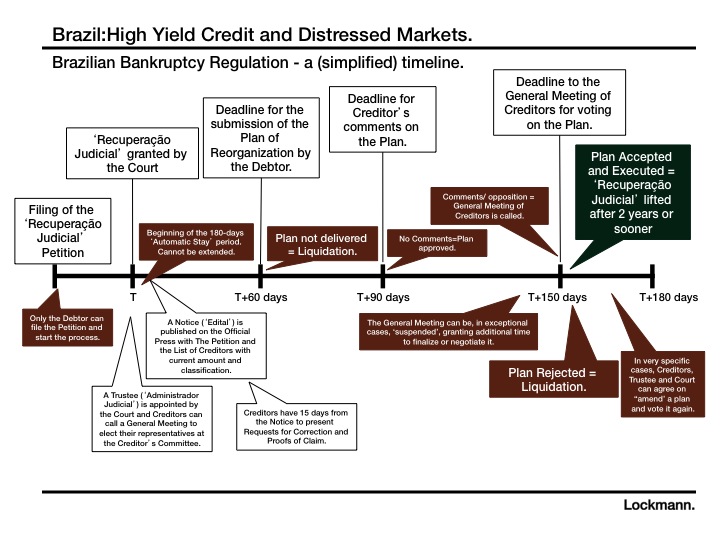
Below is a simplified schedule of a local Bankruptcy case (click to enlarge) and a couple of comments on the process:

•Recuperacao Judicial (‘RJ’) can only be filed by the Debtor and the Petition has to be filed in the Company’s main place of business and overseen by local court/judge – regardless of previous experience – with the possible exception of Rio and São Paulo that has two bankruptcy courts, most Brazilian civil courts have very limited familiarity with corporate lending/finance – what can lead to unusual outcomes .
LK-RJCalendar

•ACCs, ACEs (foreign trade lines) and ‘Alienacao Fiduciaria’ – credit backed by receivables etc. emulating the legal structure of a chattel mortgage – are not  subject to the ‘automatic stay’ under ‘Recuperação Judicial’ (as per Art.49 §3 of the Law and with recent backing by a decision of the Superior Court of Justice). More about this in a specific post.

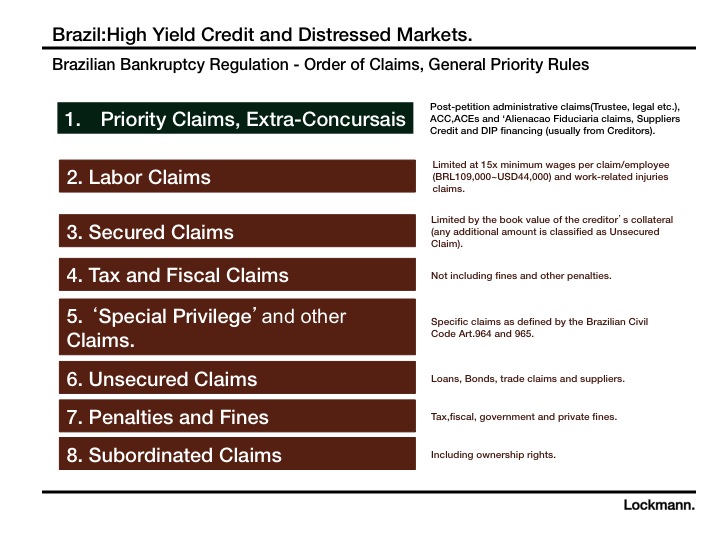
•A ‘major development’ of the (not so new now) Law was to put a cap on Labour claims (but priority over Secured Claims, continue) – please see below (click for enlarged version) – a simplified guide to the Order of Claims in a Brazilian bankruptcy case. Tax and Fiscal Claims still have seniority over Unsecured Claims.

LK-Claims

•DIP financing is not usual in Brazil and somehow ‘untested’ – that is probably why in the OGX case – creditors decided to use foreign trade lines – to add another line of safety to their claims. Prepackaged bankruptcies are virtually non-existent.

• Fast liquidation proceedings (‘Falência’) are also not common, especially  in high-profile medium/large bankruptcy cases –  even in the most obvious cases, liquidations are usually postponed for as long as possible  (in this case – the RJ/chapter 11 period dragged for over 5 years) – this obviously benefits the Debtor/Controlling shareholders and ‘forces’ creditors to accept a Plan of Reorganization that could be marginally better than waiting (a couple of years) for the outcome of a liquidation.

•Claims in foreign currency are automatically converted into local currency in the case of liquidation (‘Falência’) – creating immediate devaluation risk.

•The practical implications of the ‘New Brazilian Bankruptcy Law’ are being tested on a daily basis (the final outcome of the OGX/OSX case will certainly shape future cases, as it is already influencing cases like Aralco) –  and potential changes to the law can happen within the discussions of the new ‘Codigo Civil” in 2014/2015.

As per usual, any corrections, feedbacks and comments are appreciated. To be continued in further posts.


Upstream

Carlyle, Gávea/Apax and GP Investmentos raising new Brazilian PE Funds to invest in consumer products, healthcare and infrastructure.
Oaktree entering direct lending in Europe, after the US on another chapter of credit hedge-funds stepping in for SMEs after banks scaled back lending.
Nokia+/-Google+/-Microsoft and the ‘burning platform’ theory.
-Book covers: a set of Penguin and Pelican covers from 1935-2005.

IMG_0059

STAY PRIVATE LONGER (Bonds)

As per today’s brilliant Dan PrimackTerm Sheet.  J.P. Morgan’s Silicon Valley bankers have developed (and trademarked) a “high-tech version of mezzanine finance”.

Not enough information is public and it’s too early to understand but this is basically seems to be Silicon Valley’s version of  mezzanine bridge financing designed to give an exit to “too eager to IPO” early investors/employees with guarantees adapted to the company’s business and development stage.

Considering that SurveyMonkey (the first issuer of SPL bonds) was founded in 1999 and actually generates significant cash (2012 Revenues of $113 million and Earning of $61millions) and probably has limited need for more investments – my guess here is that early investors/employees were costly to carry and were pushing for an IPO asap – the SPL bonds (a combination of cash-pay and PIK bonds) gave them an exit and reduced cost of debt.

The complex part here is how to price and negotiate the exit (I’m guessing warrants) and the guarantees (bondholders probably have some grip over SurveyMonkey’s future cashflow and in the case of the other SPL issuer Jawbones – the actual physical inventory).  Other than that, the PIK bonds probably have a low penalty for pre-payment in the case of an equity offering and investors are also willing to ignore rules of thumbs like the max 1-1.5 xEBITDA (hit me if you have more info). All that probably demands a higher closing fee than the usual 2% and as Primack mentions “J.P. Morgan effectively has an inside track for the IPO business of both SurveyMonkey and Jawbone, not to mention for future debt and acquisition requirements.”

All in all – this seems to be an interesting remedy to EM companies – instead of extending/renegotiating over and over again bridge-loans till the IPO market is open again.

NYC-1